POST-ENTANGLED

Now what? Six years into this book project in a dubious effort to somehow express a lifetime and now-it’s done. The book is published and I’m starting this blog today with little idea of where it will take me, except maybe to just start writing something. Entangled was a modest effort at best and difficult to write for a variety of reasons. The initial idea was to be a letter to our children. It took on a life of it’s own when I realized that to convey to our kids the kind of life we (Janis and I) had, it would take a book. I didn’t like that idea; in 2014, I was not in a good state of mind. I was only starting to accept getting older and then tossed into a world of dementia, struggling with guilt and grief losing Janis to a locked unit. I needed to understand all this myself, never mind trying to express it to our kids-it seemed daunting. And that in itself presented obstacles. Would our kids even want that, especially if I decided to go public? What is the point in such an endeavor? How intimate do I dare to be in such a project? I am not a public kind of person. I tend to be private. This changed my outlook on things. (Blogging, for instance.) All of a sudden I felt a need to open this up for my own understanding and maybe in that context it could result in something that others might find, if not interesting, at least addressing some understanding about their own lives, or the life of someone else that they know and love. Annie Dillard wrote: “If we may learn to know, may we not learn to understand?”

Are we just dust in the wind, or is there something else we might be missing? I don’t subscribe to any particular organized religion. I’ve been there, done that. I realized that religions were really ‘a finger pointing at the moon’. I wanted to know that moon they were pointing at-I wanted to know it directly. Religion didn’t respond to my personal search. So at a young age I started to look into many forms of religion that served as a kind of research. I took courses in college related to philosophy and comparative religions and sought out opportunities to be involved in any services that were available to me. I traveled around a little (including while posted overseas in the military) and attended different religious services, read anything I could find, tried out different forms of meditation and settled in my early 20’s on zazen meditation. Zen is not a religion, though it is often viewed as, and associated with Buddhism, Zen is considered more as a tool/method to a way of life, (Shikantaza) and can be attached to any religion, or to none at all.This led to a hobby of sorts in theoretical physics and more recently an interest in the ‘new physics’ and quantum physics that has a comfortable relationship with some of the experiences that came out of my personal quest for a cohesive sense of understanding why we are not just dust in the wind. While writing Entangled I did not plan on getting into my own philosophical quest, but it seemed so much a part of what explained to me this connection of events from my youth up to today that it couldn’t be ignored in Entangled.

I’ve mentioned along the way recently that Janis is my life’s koan. I mean by that that my life has always been about this relationship. Even long before we met. I’m not going to expound on that too much. It’s too complex and is indeed a koan-a paradox, a riddle that defies logic and/or exposes the limits of logical reasoning in understanding the inexplicable. Trying to explain any further than that is not reasonable in this text, and requires some self-study that meditation can assist one with.

So I suppose that beyond promotional stuff I still need to do, Entangled is a closed book.

I’m hoping to get through 2, possibly 3 more books before joining the walker-crowd, wearing Velcro-laced white sneakers, and living on Progresso soup and PBJs. (Wait-except for the walker and the sneakers I’m already halfway there.) I’ve learned from experience that I don’t do well by finishing one book and then jumping too quickly into another. In this case, maybe a little longer given the investment of emotion and time I spent on this one. I’m kind of thinking about another non-fiction work. But, can’t decide what that would be. I am in the early stages of getting A Certain Fall, republished with an additional, added text to the work. I have the rights to the contracted book back and some ideas for adding/updating it. Other projects that I started years ago but left undeveloped are also still interesting to me. One of those has some elements of a work of fiction based on actual events that occurred during my work in the military. I like this idea. The other book I started and still have interest in is a straightforward work of fiction. A novel set in a small fishing community located in coastal Maine. This one would be another attempt at a character-driven novel similar to my earlier effort at this genre in Mother, Night, and Water. I’m looking forward to both of these as possible next projects, and another educational experience/training in writing, especially because I have them both started and moving me into the next phase of their writing. On the other hand, I always enjoy starting fresh. I love the work. But, also now after 4 books, have enough experience that I understand the words: “If your writing comes easy, you’re doing something wrong.”

Leave a comment

Filed under Uncategorized, Writing

FORGIVENESS/ACCEPTANCE

(A Precursor to ENTANGLED)

I like words. When I was a boy, maybe 10 yo or so, my mom picked up this huge dictionary. I mean, it was heavy and required its own table to set on. I recall flipping through all the pages in wonder of the number of words I was going to have to learn. Of course, I didn’t. But I was enchanted by this book. And later when I started writing (age 13 yo) I began to think about words, dictionaries; just imagine what I felt like when I discovered a thesaurus. The birth of a dork.

Eventually I began to understand not only that most of my friends, at that age primarily guys, were not as interested in words. But I evolved in my wonder of this new world of words and started using words with an aim to be precise. Or at least I aspired to that end. So when I write now as an experienced, but still a student of the craft of writing, I am a little picky about vocabulary and precision of choosing words with hopefully a little more skill. This is especially true and a challenge in the writing of Entangled .

I was invited into Janis’s therapy at some point because she was missing a lot of the nuances, and recall of her history. So I continued with this therapist after Janis was placed. It started out as an assist with grief, but has now become as much about my understanding of what we went through together as a result of her abusive history, and major mental health issues due to this history, as my grief. Therapy turns out to be a self-exploration and analysis of how this marriage survived. And a new, or renewed, respect for what Janis went through all the years of her life. The therapist told me grief is not a feeling. Huh? Another word to clarify. Or a zen koan?

I avoid absolutes, in general. I look around me and see that extremes nearly always create harmful outcomes. In general. Life has extremes, naturally, but life for the most part runs somewhere down the middle. A lot of compromise goes a long ways toward peace. World peace or just peace between people. The theme of any relationship can be viewed this way. Nations or couples. Friendship or enemies.

Forgiveness or acceptance?

I’m mostly referring here to child victims and the adults they become. Forgiveness is a loaded word. Ask what forgiveness means, and a plethora (I like that word) of scenarios floods my mind. Most of which are firmly entrenched in our cultural and religious traditions. I have no problem with that except when we are trapped with a definition for a problem that does not work. I’m not prone to the idea of free will; like forgiveness, I think there are complex definitions of this idea; biological, genetic and epigenetic, neurological, religious definitions…I find myself stuck.

The word forgiveness is fraught with emotion making it difficult for people to work through when they have been wronged. In my work I found myself struggling with how a child understands that word. Or how his parents understand (i.e. stand-under, or support) an offender who has harmed their child in ways that sometimes are so pernicious and far reaching, that it seems unforgivable, Are we really supposed to forgive? See, I’m stuck. And that’s what this is all about in the book, Entangled. Not if we can forgive, but, can we accept. Do we punish the victim–the child? Of course not. And the perpetrator? Forgive? Tell me what that word means. Who is required to bear responsibility, accountability? What’s the difference between these terms? What happens to the victim as they become adults? Do we then hold them responsible by expecting them to forgive. Or do we choose to look at our own behavior and consider the options we have for this child/adult victim that we love?

I’m responsible for how I respond. That’s it. We are what we have done. We are what we do. That’s as far as I’ve gotten so far in challenging myself to look at the victim who is experiencing life awash with emotion, and instead of responding to the matter with anger, shame, disdain, or passivity, or some other cheap response that exposes its own extreme degrees of outcome, I get to accept responsibility for how I respond. Not expecting or holding the victim responsible for their offender’s assault on them, by asking them to forgive. In the case of assault to a child, we now know the neurological impact on the child’s brain and development. Accept or reject. Not necessarily forgiveness–whatever that really means. What we wish for these adult victims is to ‘move on’, forgive and let go. Because their condition is hurting us, and we want it to stop. We want them to be happy and have a good life, so that we can move on. Have a life. It’s this selfish desire to have things be the way we want them to be that creates this distress for us. Sadly, many of these survivors of abuse are suffering neurological consequences that make them unable to live the life we would hope for them. So what are we left with if we commit to them? What is our responsibility in these circumstances? Understanding all is to forgive all? Discount the victim for not getting over it? (Just snap out of it?)

I can take responsibility for how I respond to the victim–their condition. Accept them–just as they are. To offer unconditional love. Caritas, that term that describes the deep compassion for the other person’s plight, their condition in life. Is the victim responsible for their condition, do we expect them to take responsibility? Or, can we hold them accountable for their behaviors instead. Forgiveness implies the victim’s responsibility for their circumstances; acceptance expresses understanding, but expecting them to be accountable for what they do, not who they are. A word: Love. Overused, vague: We love our cat, we love our cell phone, we love mac and cheese, pizza, beer, sunrises, sunsets, our four-wheeler, our car, our coffee. But I’ll be damned if I can come up with a better word for how I love my children, my grandchildren, my life–my wife. The word Love seems to cover that just fine.

Compassion is not all warm and fuzzy. In fact, in the words of Pema Chodron, it’s actually raw. It challenges us to change. The challenge for us is to remain compassionate.

2 Comments

Filed under Alzheimer's, child abuse, dementia, mental health, Uncategorized

LYING. (warning: wearing pontificating hat.)

I think most reasonable folks would agree that lying is not a good thing. However, I doubt that any of us have gotten through life without at least telling one lie. Right? I also think that there are exceptions when lying is understood and acceptable. Maybe even kind. For example when someone with dementia asks about their mother or father, family member, or close friend who has died in the past: I recall my father, who died with dementia, asking about one of his friends who was gone. I told him when he asked that his friend had passed away. Dad cried. The next visit he asked how his friend was doing. I hesitated, then told him his friend was getting older but was doing okay. Dad smiled.

Okay. I just lied. The next time Dad asked, I again told him that his friend had passed away, I lied to you because I didn’t want to come across as a smug know-it-all. And also to make my point a little more pertinent: Repeating that interaction over and over again would have gotten the same response from Dad. How do I know this? Because I did repeat it a few more times before I realized how unkind–cruel even–that was for Dad. So…I Iied, and Dad was okay with that. You can see where this would have gone if I had continued to beat him up with the truth.

So, the truth is important not just on important matters, but even on a humane personal level. Except there are exceptions; and when in doubt I suggest err on the side of compassion. But beware the truth will prevail. One way or another it will come back on you, therefore consider your lie carefully, humanely, and with compassion.

We are in a difficult time. Our world as we knew it is standing on its head. And rather than preach about this topic to you I will refer you to a far more credible and eloquent source who’s established himself as a philosopher as well the prominent scientist of our lifetime:

“Lying destroys confidence in the statements of other people. Without such confidence, social cooperation is made impossible or at least difficult. Such cooperation, however, is essential to make human life possible and tolerable. This means that the rule ‘Thou shall not lie’ has been traced back to the demands: ‘Human life shall be preserved.’ and ‘Pain and sorrow shall be lessened as much as possible.’ ” ~Albert Einstein, Out of my Later Years, Philosophical Library, New York, 1950.

I don’t know if aging necessarily leads to some degree of wisdom. Recent events would lead me to believe not. Still, aging to the place of a gray-haired senior does at least allow for (if you’re willing to venture there) evaluating one’s life experiences: good and bad, and drawing some conclusions from your life. In writing Entangled a sort of memoir, I’ve struggled with decisions about what to include and not include, I’ve engaged with a depth of emotions that challenged my judgement to the point that the book almost didn’t get published. It’s been sitting on my laptop awaiting a decision. Leaving stuff out of the book forced me to consider what that meant, is that a form of lying? Who would know? Me. I would know. In the end I’m the one who will have to deal with anything that may not make it into print, but I also know that compassion was my measure. This includes both Janis and myself as well as some other persons, some who will know who they are and will know what was left out. I am not apologetic for the story. I will say that the text as it is written is my honest effort for truth. Whatever I have left out was determined by my compassion for us–Janis and myself and our sincere love for one another, our marriage–I married my friend.

Any extreme is suspect for hurt and danger. Any extreme, even compassion. But, when in doubt err on the side of compassion–caritas, unconditional love and caring will be easier to forgive.

Leave a comment

Filed under dementia, mental health, Uncategorized, Writing

Spring at Widgeon Cove

There are many hiking trails down here in Harpswell, Maine. I’ve visited some and still checking out others. Spring has come finally to southern coastal Maine. My companions on these excursions are few: my 5 yo granddaughter, Brinley, loves the hikes and the woods. My other frequent companion is my good friend, Jim. Jim is a little older than Brinley. Closer to my own senior status. (In fact, just a smidgen older.) But, usually I go alone, this is because I like to go on impulse between other activities on my busy calendar.

Each trail is unique with their own offerings of the coastal forests. All trails are rich with the scent of Maine’s conifers, sweet firs and varied brush. Pine, spruce, junipers. The birds are back and provide a soft, songful background to the scene. I met a fox on one trip. He was trotting through the shrubs and crossed my trail, with only a quick glance at me. We both were caught by surprise. Another time I ran into a family of deer. Widgeon Cove is a deep experience. Dark in places with drops into sylvan dips and turns. A few small climbs with trails that split for different sights and views. The coastal forests have suffered over years from strong winter blusters and ice storms, including the ice storm from the 90’s. It has left evidence: damaged trees, sometimes serious, fatal damage, exposing their guts and inner workings; some of these uprootings reaching my own height, other trees busted off above ground level sharp, splintered spears pointing skyward. Some older, larger trees crashed and dying, yet are held up by other sturdier trees. But, on closer observation the forest is growing back with new, green spruce and pine and a few birch and oaks. Life goes on.

For followers to this blog you won’t be surprised if I bring Janis into the picture. I’ve discovered, or become more aware that my nostalgia for all that concerns Janis is unavoidable. It is most heavy at the change of seasons. Seasons without her. Last month we were finally allowed in-person visits. We both have been fully vaccinated. I was able to be with her in her room for 3-half hour visits. These visits are what I call Covid visits. They have to be scheduled and are not daily. However, recently there was a scare after a person tested positive. Not anyone on Janis’s Unit. The facility holds nearly 200 including a Rehab Unit and Nursing Home. They have paused the visits until they re-test everyone in the entire facility. Including staff. This requires several days. They test all persons three times. So far the tests have been negative. I’m rescheduled for next week, assuming that all 3 tests come back negative. There is one more test. The results are due this Friday. So I didn’t have the opportunity to visit her on her birthday. I did send in a dozen roses. And I called her. This is a one way conversation but I’ve done this before and it has been quite successful. Staff hold the phone against her left ear (Janis is deaf and lost speech) and I talk to her. This is brief, partly because Janis’s attention span is lost after a few minutes, and it ties up a staff person because she can’t hold the phone herself. But these brief calls give her smiles and recognition that I have not forgotten her.

I’m going for a hike this morning just up the road from where I live, Curtis Cove. This hike also involves some hills, and also a large open field. I see more hikers on this trail. It’s popular. This is where Brinley and I go most frequently. Also, this Friday I’m meeting up with a man who was a boy in the camping, groupwork program I ran in the 1970’s. We connected via Facebook and have stayed in touch for a while now. Strangely…he’s no longer 12 years old and I’m no longer in my 30’s. As a kid I recall he did a great Steve Martin impersonation. “I’m a wild, and crazy guy!” Glen remained in the groupwork program for a few years and as a teen he helped me supervise outings, including a winter carnival in Quebec City, with younger kids. Several kids from that era of my life have stayed in touch. It pleases me.

4 Comments

Filed under child abuse, dementia, mental health, Uncategorized, Writing

A Moment In This Life

The present is the only thing that has no end.” ~Erwin Schrodinger

On March 8, 2020, with no preparation or notice, my visits with Janis were interrupted. Covid had hit. So until September that year, we had no contact. (Keep in mind that I was visiting nearly every day for several hours a day.) Following that, we were set up to do virtual visits on a tablet or laptop. This did not work well for Janis. Her cognitive issues were too advanced and she didn’t seem to know what was going on. But we kept them up once a month. So later that Fall we went to outdoor visits in the Garden at her Unit. These visits were highly structured with masks, separated by plexiglass, and supervised. As winter approached this arrangement continued indoors…the same set of rules and separation. All of the above were allowed 15 minutes.

On March 17th, 2021, one year later, we were allowed our first full-contact visit.
Since I write this blog for public publishing, some of you have received some updates already, so this may be a little more detail, but also repetitious in places.
Hang in there.

All week long I worried. I was concerned she might not recognize me. I worried about her response to me after so much time apart. I was up early Wednesday morning and prepped for my visit. I had ordered a dozen red roses in an arrangement, and I even used a little Old Spice, thinking that might jog her memory a little. (I was careful to not splash it on. Fearing I might put off the staff on the Unit (enter modest emoji here. I don’t have emojis on this blog??? I do. But how do I do it?). I left Harpswell early to arrive in Lewiston early, on the way I kept the radio off and tried to keep my expectations constrained. (Not successfully.) A sunny morning with warming temperatures made it a little better.

I’ve often spoken about this Unit and Janis’s care with glowing words. They deserve it. And, I have spent many hours on that Unit including a month of 24/7, I moved into a private room on that same Unit, for Palliative Care for Janis in October/November 2020. I lived there. Since then they have maintained contact with me via candid, texted photos of her and little details about her days. They are the direct service CNA’s, (esp. the Med Technician, Katie, and Sarah;) as well as the Nurses, and Activities Director, all wonderful, compassionate people, including the Facilities staff and the Administrative Assistant, Marilyn. When I arrived at the Unit, all these folks spoke to me on a first-name basis. Hugs and smiles, “Hi, Bob.” They know me well. (Of course, I schmooze just a little, sending them much-deserved flowers occasionally. They are so kind and respectful to Janis and all their residents.)

When Janis spotted me she broke into a laugh and we hugged (I’ve learned how to give a wheelchair-hug) and held hands the entire 40 minutes I was with her. Never let go of her except to change position or change hands. Aside from needing a haircut, Janis looked good. She attempted to speak a couple times but has lost most of her language, pretty inarticulate, but I would hug her and tell her I love her. Speaking into her left ear (the only one that has a smidgen of hearing still available to her.) At one point I took out my phone and played a song that Maya and I had composed. Titled: Silvery Kite, Maya composed the music on the piano, a beautiful composition, and provided the vocals. I supplied the lyrics. When I played it into Janis’s left ear she beamed and I told her it was a song that Maya and I had composed. It was for her. She chuckled and listened, I played it again. Janis and I spent most of the visit watching each other and smiling. It’s difficult to convey how pleasant this visit was, we were so caught up in the moment with each other that we went over our allotted time of 30 minutes. Nobody interrupted us.


When it was time to leave, I hugged her and told her I would be back. As I left and drove home, I felt overwhelmed but relieved that we had held out for a year and now we were back. These visits are limited (staffing is the issue) but I’m lobbying for more than one visit a month. I’ll take what I can get. As long as Covid is stable the visits may evolve back to something like normal.

And now? Well, now I wait for that next moment when we will connect again. Our moments can be seized by each of us and held hostage by way of a digital process (or the old way on film) that we know happens when we click that little button, but how does that work exactly, and does it mean anything? How is that image captured–exactly. I’m sure that a technician or scientist could elaborate the inner workings of the instrument but still, how does that happen? Shouldn’t we know this? It seems important to understand this. I wonder? Does this contain a glimpse of eternity?

What is a photograph? I mean, we know that the camera somehow captures the photo, but how exactly does that translate into a photograph? That moment in time clicked and captured digitally somehow? It’s the ‘somehow’ that I’m asking about. It’s like that reporter that wrote to Stephen Hawking asking about his ‘string theory’, “That’s wonderful Dr. Hawking, but what does it mean?” I wonder at times about such things. Is it about the energy that our nervous system can receive from this constellation of particles by our consciousness–that moment in time?

But, what does it mean, Dr. Hawking?

Janis~3/17/21

Leave a comment

Filed under Uncategorized

Leave a Reply

3 Comments

Filed under Alzheimer's, child abuse, dementia, mental health, Uncategorized

ENTANGLED

4/8/2019 Monday

“slumped in her wheelchair she looked uncomfortable. I struggled to get her more upright. She’s dead weight now. She smiled and looked into my eyes when I kissed her. (A flash of recognition?) She has been without language for a while now. And there are longer periods of time when she is clearly not connecting anymore. Vacant and passive. But this morning a little more Janis. When she smiled after the kiss, I was overcome, and I tried to hide this from her. It is what I live for these days, to just see her happy even if it is just a brief, buoyant moment.”

This is an entry from my diaries that I have included in the book. It was just a few days after a decision had been made to get her into hospice care. Later, that September 2019, she was dying. Hospice and her physician decided to move her into palliative care in a private room on the same Unit with the same staff taking care of her along with a hospice worker. I’ve been reviewing the book and wanted to include this entry in the blog. This was the beginning of a new period that continues today for me and for her. I spent a month living in her palliative care room with her, 24/7. I left only to get meals in the cafeteria and to shower at my son’s house a couple miles away. I massaged her and exercised/stretched her legs and arms. I talked to her. Lots of hugs and kisses. I slept near her and evenings I sat holding her hand while watching TV. She rallied and made an amazing recovery. Some staff called it a miracle. Her hospice nurse told me that in the 24 years she had been in nursing she had never seen such a comeback.

Today more than a year later, I find myself ruminating about this past year. Janis had managed to regain some of her earlier capacities, the one most notable was her previous limited ability to interact and connect with me and others around her. She could laugh and smile and though she was still in a wheelchair, she started trying to feed herself again. All this was, naturally, not a recovery from dementia, but a return to a significant degree of quality of life. It took some effort on my part to not hope for more miracles. But, that was not to be. Still, we could be together again, laugh and share affectionate moments; and I was grateful for that much.

Today, I can’t be with her because of the Corona – Covid 19 virus and the restrictions on visits. That month with Janis last year, is a treasure now. A gift that gave us an opportunity to feel close. I don’t know how much longer she can hang in there, but I feel we are losing time, precious time, not being together and holding onto each other. I can see in her face (or maybe it’s a reflection of my own face) a sense of confusion and sadness. We visit once a month for 15 minutes, separated by plexiglass, wearing masks. There is no conversation (she is deaf and has lost language). Strange how I look forward to these sad visits. I just long for that close proximity to her. But it is a new life living with Covid. It appears that we may be on the brink of a vaccine that might make it possible to start cautious visits without plexiglass, maybe later this spring/summer of 2021.

Meanwhile, I have returned to part-time work at Bowdoin College. It’s 2 days a week and I’m able to make my own schedule. Bowdoin College has been in my background since I started as supervisor of security in the college museum of art in 2007. I chose to go back to work, it has helped me structure my week…my time. However, I am not back at the museum of art. The museum is closed to the public and open only a day or two per week for administrative employees. I work in Security and my job is outdoors so I’m pretty safe wearing a mask. I am required to do a Covid test once a week and I am not in close contact with others. I also do childcare for my grandchildren a couple days a week for just a few hours. I love that contact, it keeps me smiling. I try to follow the news, but on a limited basis – too much craziness going on. I’m still in counseling and do this via Zoom a couple times a month. The rest of my time is spent on chores, housekeeping, and writing. I’m busy. I work out every morning. Hike. It’s good. Mostly good. I’m good. I’m healthy. I’m lucky. I miss Janis.

*

The book, Entangled, is in the process of finding a publisher. I’m sending out query letters for publication.

Janis August, 2020.

2 Comments

Filed under child abuse, dementia, mental health, Writing

JANIS ON A RAINY OCTOBER DAY

October is a beautiful month, but as it winds down and the bright colors fade, it can create a completely different picture.

On a rainy October day, 2020.

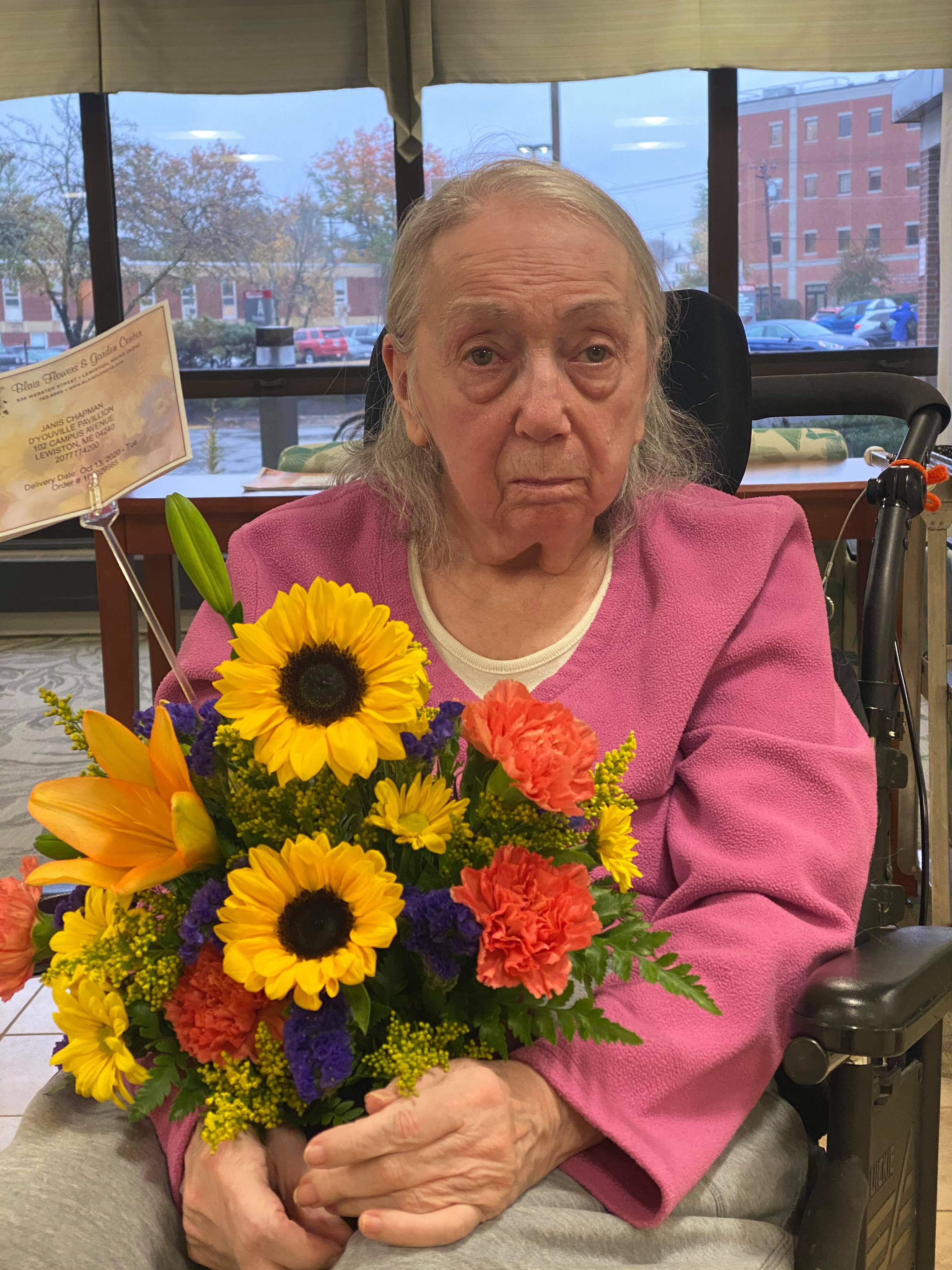
On October 13, 2020, Tuesday last week, we had another Corona Visit (defined briefly, because it is brief, as a 15 minute protected visit. No physical contact, masks, plexiglass.) I posted a photo on FB today of Janis holding a bouquet of bright colored flowers I had ordered to coincide with my visit. Marilyn, the Administrative Assistant took the photo after our visit ended. Janis was having a down day today, late in the afternoon. As gray a day as possible, with showers. She did not interact much at all today, the visits are very quiet. At the end I was reluctant to leave, but there are others awaiting their own Corona visit, sooo…

UPDATE: I received a call a couple days after this visit from Janis’s brother who told me that they had heard on the news about the Virus getting into D’youville. It was late and I tried calling but it was busy. So the next day in the morning I called and the nurse (a recent RN graduate from U of M, who was one of Janis’s CNAs when I was visiting last year. She returned to work there as an RN, that’s the kind of Unit this is!) She assured me that the staff and vendors who contracted the Virus had no direct resident assignments, and the vendors also were not directly in contact. All residents have been tested and all came back negative. Janis’s Unit is clear. She also told me that Janis was having a good day and all her vitals are acceptable. She’s eating well and awake most of the day. I’m keeping this post brief but feel free to contact me via FB or my email if you have other questions.

1 Comment

Filed under Uncategorized

THROUGH A PRISM

I suppose no one has noticed that the Facebook entries have pretty much been about Janis. (For me it has always been about Janis.) I can’t say how many times I’ve attempted to write about her. The current book that sits quietly awaiting my attention for publication is completed. Except, as I re-read it I find myself still wrestling with the feeling that I will never be able to relate the minutiae of our life. Not in a way that will satisfy my effort to convey the complex relationship with this girl who took my heart as a boy, and looking for love and trust, weaved her damaged little girl into our life. She always turned to me when her life spun out from under her. She depended on me for safety, acceptance with no strings attached, and she trusted my loyalty to her. It will be a life’s work to understand it myself. I refer to Janis as my zen koan.

In the writing of Entangled and Love in the Time of Corona, I wanted to express through a linking of different approaches to how entangled we were. I explored it by way of psychology, spirituality, science, philosophy, and our poetry (poems simple, but sweet). Still, it feels ineffectual. I also note that it is unlikely that my meager effort to delve into this relationship can be achieved by tossing this mixture in such a cursory way. My hope is that at least if there is any interest in the dynamics that I present, in the shallow text of Entangled and Love in the Time of Corona, others may search through the listed sources/resources for a deeper understanding of their own relationships within friendship, love, and marriage. It is my experience and belief that commitment, compromise, and compassion are essential. This is especially true in marriage. It’s the difficult times and the good times–maybe, even more, the difficult times–the understanding of what the other brings from their life into yours–this is the magic. If it’s love that is the motive and not just the contract, that assures that it is virtuous. Caritas is a Latin term for unconditional, selfless love. This is the core of all spiritual teachings. As Jacquie Wallen has written, “Giving freely and generously without reluctance or compulsion, what we have decided in our hearts to give.” (see also, 2 Cor. 9:6-7) It’s this caritas that distinguishes between a codependent relationship and a compassionately based decision (in as much as Sapolsky’s* work dismantles the notion of free will, and intended or not, opens the quantum field to the concept of karma). There is such a thing as stupid compassion, and some relationships need major adjustments. Any extremes, even with compassion, are problematic and create issues that need common sense and reasonable responses. But when in doubt, choose compassion.

When I fell in love with Janis we both were kids. I had no idea of her past abuse, I only knew that I loved her, she was my friend. As time passed it was the gradual awareness of all that she had lived with up to the time we met, that weaved her into my world and we cleaved together with the love that we each had for the other. We were already entangled long before we met, we just didn’t know it. The motivation for writing the book by that title is about this cleaving, this weaving of our lives, of our hearts, of our beings. It is my effort to understand how two people from opposite sides of this spectrum (defined as “a continuum of color formed when a beam of white light is dispersed, as by passage through a prism, so that its component wavelengths are arranged in order.” **) of childhood experiences, found each other. It’s not original, but it happened to us so it’s original to us, and I’ve spent these last few years grappling with this in wonderment.

Confession: I’ve been hanging onto this book for reasons that are personal. I want to publish it, but I’m reluctant. (Some have previewed the book, a few friends, professionals, and family members) some of which have read the manuscript and offered that the personal intimacy of the book was uncomfortable. I acknowledge that. Very much so. However, I feel strongly about the issue of child sexual abuse and the long-term impact it has on the victim and later on, in their marriage and families–their friends; and it is also for those predators who take advantage of vulnerable others for their own purposes, to maybe–maybe, understand that what they do is harmful. Society suffers also, for instance, the economics of treatment sometimes a lifetime of treatment, institutional/incarcerations, placements, and medications, substance abuse, physical health…and more. The karmic range of this web of betrayal and violence is wide and destructive to our lives–to our human ecology. The subject of this book is larger than just the story of Janis and me. Using us and our life together in this uncomfortable story feels like a sacrifice, because it is. Giving up just this small part of our story is intimate and revealing of the hurt, the damage, the personal pain. The daily battle. It is a sharing that hopefully gives some purpose for Janis and her life. She wanted that: for her life to mean something. She participated with me in workshops and shared her childhood with people. I ask that readers use compassion for the young girl who became a friend, a woman, a wife, a mother, an artist, a survivor with the invisible wounds that came along with her into the rest of her world.

So…with love, risk–hope, and with few regrets, Entangled and Love in the Time of Corona is presented with minor adjustments (for the sake of intimacy for some).

___________________________

*Behave, The Biology of Humans at Our Best and Worst, Robert M. Sapolsky, Penguin Press, 2017.

**Merriam-Webster Dictionary.

2 Comments

Filed under child abuse, dementia, mental health, Writing

JANIS~ Corona Visit–October 6, 2020

As soon as I got out of work today, (I’m back at Bowdoin College part-time) Tues. 10/6/20, I got in the car and drove the 45 mins to Lewiston to keep my Corona visit (15 minutes) with Janis. I posted a photo of this visit courtesy of Marilyn the administrative assistant who has been so gracious over the years with Janis. She has become a familiar name with our family among others there who have become special friends.

This visit was our first visit inside the facility in preparation for winter. Dyouville Pavilion, in keeping with their serious and compassionate care for their residents and staff, built a temporary meeting room into their lobby. Warm and comfortable. Janis seemed more alert and in touch with this visit. Of course, she wasn’t always able to interact given her numerous handicaps, but I enjoyed the few times she was joined to me in the visit with smiles I could see beyond the mask. A couple times she smiled so broadly I could see her eyes shine; then she would withdraw a little. I interpret this as attention span issues, and maybe the emotional intensity of these limited visits.

I was able to get a little closer to her than the outdoor arrangements allowed. I got right up to the glass and took out my phone to show her some photos of our grandchildren which she showed interest in, at least for a while, later I showed her a photo of one of her own art creations that I had on my phone. When she finally glanced at it, she burst into a big smile and nodded. I clung to this moment, but it drifted. I did my usual mime act of displaying my love for her. She saw this and nodded then looked away and gently, slowly shook her head as if she didn’t want to react to this. I noticed that she was a little emotional and tired. We spent the last few minutes looking at each other–well, mostly me looking at her. She made some genuine efforts, I thought, to my presence and later, as I waved some kisses and prepared to leave, smiled again with another bold, eye-to-eye connection. For those who read this who don’t know: Janis is deaf and has lost a great deal of cognition and language. So, this visit was quite a positive experience for us both. Given that it is only 15 minutes and there is no conversation, I was overwhelmed as I left her today.

I will be able to visit again on the 27th of this month, and Thanksgiving Day, and Christmas Eve. I look forward to these limited visits. They keep me hopeful and feeling close to her. It was my hope as I drove home, that when this Coronavirus allows, we will be together again and she will remember me. These visits and the Zoom visits are enough, I hope, to keep my face in her memory.

So now, I’m going to attempt to attach the photo that I put on Facebook into this blog entry. We’ll see. Thanks for joining me in this blog. It’s my objective to keep Janis in our world and thoughts…

2 Comments

Filed under child abuse, dementia, mental health, Uncategorized

JANIS~A CORONA VISIT

A cool autumn afternoon with a shifty breeze. Janis appears in her wheelchair bundled up in her blue penguin blanket, one of those many gifts she received over the years from a wildlife organization. Today is Tuesday, September 22nd. It is a 4 pm visit. Karen, one of the activities personnel from her Unit brought her down for today’s 15 minute-Corona visit. The visits take place outside in the garden, in a large gazebo. The garden still beams with colorful flowers that blur into the changing fall foliage like an impressionist painting. This is only the second visit I’ve had with her since March 8th. These visits take place under some strictly enforced protections for the residents, staff, and the visitor. Plexiglass surrounds Janis on 3 sides and masks are required for Karen and me–the exception is Janis. (I haven’t asked, but I assume it is to protect her from us; and certain dementia patients present a unique problem for a mask.) The entire complex has not had a single case of the Covid-19 virus to date!

Janis notices me before I get to my chair (placed 6 ft. from the plexiglass) and followed my eyes all the way to my sitting. She seems more alert to me than the previous visit, and connects quickly. Again, for those who don’t know this already, she is deaf and cannot speak. Our visit requires a little skill on my part with mime. But I’m not shy, Karen is the only other person present, and I know Karen well. So I proceed with smiles and mime my happiness by patting my heart and tossing my open hand, throwing her kisses, and mouthing, “I love you. And I miss you.” Karen permits me to remove my mask briefly so that Janis can see me. A small, tentative smile from Janis is accompanied with a nodding of her head. Of course I am moved by this out of proportion to the actual behavior. A little giddy with excitement, I want to hug her and hold her hand. We have used up a few minutes already with this emotional greeting.

I use a little time conversing with Karen about Janis on the Unit, trying to keep our connection by never taking my eyes from Janis. Karen relates that staff is still impressed with how Janis’s recovery last Fall allows her to be comfortable and maintain good spirits. She says that Janis laughs frequently and responds with smiles and giving gentle pats for the care that the aides and nurses give her. She is often in light spirits. She occasionally feeds herself or attempts to with little assistance. Her appetite remains good and she is healthy. The entire time Janis gazes around at the garden; she smiles at Karen when Karen readjusts her blanket after a stiff breeze blew it off her lap. Karen also confirmed information that the administration is looking for ways to continue these visits inside as the weather shifts to winter temps.

Janis makes eye contact more frequently as the visit continues. I observe that Janis’s weight seems stable and she is far less ‘puffy’ (edema) than previous photos of her have shown, her color is good. In fact, she looks pretty good overall. I also wonder if those Zoom meetings that take place between visits (not as frequently as I would like) have something to do with this slight improvement with these limited, physical visits. The Zoom visits are not very successful in connecting with her. Janis seems to not understand this techy, virtual, substitute visitation, but it provides me with a few minutes to observe her even as a mostly one-way visit.

As our time runs out I notice my anxiety increases, however, I also note that I am less disturbed than I anticipated. And this bothers me some because I don’t want this to become the new-normal. I don’t want to accommodate to this crazy, bizarre new world for Janis and me. I want to hold her close. I want her to feel loved, to know I’m Bobby, and I’m still here with her; that she is still Bobby’s girl.

My next visit is scheduled for Tuesday, October 27th at 2 pm. A long stretch without being with her. I respect and appreciate this effort to keep her safe. And I support the restrictions this pandemic requires. However, this is becoming difficult. I find myself less patient and more concerned as time goes on. After all, time is crucial. Janis has a fatal, incurable condition. I have been with her on this Unit long enough to see how unpredictably the final day may arrive. Seemingly healthy residents one day are gone the next.

These are strange, byzantine times. Challenging in complex ways. Requiring absurd adjustments that don’t come close to normal (which is becoming an absurd descriptive term in itself). The world as we knew it seems to be standing, wobbling on its head. Like a Kafka novel on steroids.

As I’m leaving, I don’t look back. But, before I’m out of sight, Karen calls,
“Bob, she’s laughing and smiling.” For just a moment I catch myself–maybe Karen is just making sure I’m okay with this. But, I turn and wave goodbye.

“Patience is not endurance, it is loving acceptance.” ~Robert Aitken.

2 Comments

Filed under Alzheimer's, dementia, mental health, Uncategorized