
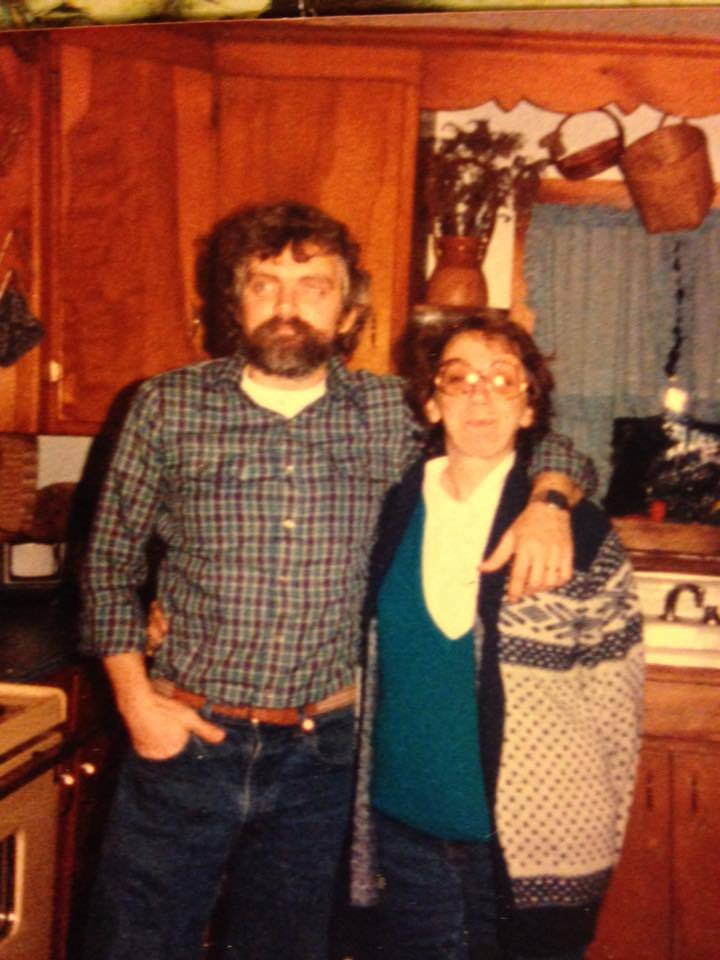
I suppose no one has noticed that the Facebook entries have pretty much been about Janis. (For me it has always been about Janis.) I can’t say how many times I’ve attempted to write about her. The current book that sits quietly awaiting my attention for publication is completed. Except, as I re-read it I find myself still wrestling with the feeling that I will never be able to relate the minutiae of our life. Not in a way that will satisfy my effort to convey the complex relationship with this girl who took my heart as a boy, and looking for love and trust, weaved her damaged little girl into our life. She always turned to me when her life spun out from under her. She depended on me for safety, acceptance with no strings attached, and she trusted my loyalty to her. It will be a life’s work to understand it myself. I refer to Janis as my zen koan.
In the writing of Entangled and Love in the Time of Corona, I wanted to express through a linking of different approaches to how entangled we were. I explored it by way of psychology, spirituality, science, philosophy, and our poetry (poems simple, but sweet). Still, it feels ineffectual. I also note that it is unlikely that my meager effort to delve into this relationship can be achieved by tossing this mixture in such a cursory way. My hope is that at least if there is any interest in the dynamics that I present, in the shallow text of Entangled and Love in the Time of Corona, others may search through the listed sources/resources for a deeper understanding of their own relationships within friendship, love, and marriage. It is my experience and belief that commitment, compromise, and compassion are essential. This is especially true in marriage. It’s the difficult times and the good times–maybe, even more, the difficult times–the understanding of what the other brings from their life into yours–this is the magic. If it’s love that is the motive and not just the contract, that assures that it is virtuous. Caritas is a Latin term for unconditional, selfless love. This is the core of all spiritual teachings. As Jacquie Wallen has written, “Giving freely and generously without reluctance or compulsion, what we have decided in our hearts to give.” (see also, 2 Cor. 9:6-7) It’s this caritas that distinguishes between a codependent relationship and a compassionately based decision (in as much as Sapolsky’s* work dismantles the notion of free will, and intended or not, opens the quantum field to the concept of karma). There is such a thing as stupid compassion, and some relationships need major adjustments. Any extremes, even with compassion, are problematic and create issues that need common sense and reasonable responses. But when in doubt, choose compassion.
When I fell in love with Janis we both were kids. I had no idea of her past abuse, I only knew that I loved her, she was my friend. As time passed it was the gradual awareness of all that she had lived with up to the time we met, that weaved her into my world and we cleaved together with the love that we each had for the other. We were already entangled long before we met, we just didn’t know it. The motivation for writing the book by that title is about this cleaving, this weaving of our lives, of our hearts, of our beings. It is my effort to understand how two people from opposite sides of this spectrum (defined as “a continuum of color formed when a beam of white light is dispersed, as by passage through a prism, so that its component wavelengths are arranged in order.” **) of childhood experiences, found each other. It’s not original, but it happened to us so it’s original to us, and I’ve spent these last few years grappling with this in wonderment.
Confession: I’ve been hanging onto this book for reasons that are personal. I want to publish it, but I’m reluctant. (Some have previewed the book, a few friends, professionals, and family members) some of which have read the manuscript and offered that the personal intimacy of the book was uncomfortable. I acknowledge that. Very much so. However, I feel strongly about the issue of child sexual abuse and the long-term impact it has on the victim and later on, in their marriage and families–their friends; and it is also for those predators who take advantage of vulnerable others for their own purposes, to maybe–maybe, understand that what they do is harmful. Society suffers also, for instance, the economics of treatment sometimes a lifetime of treatment, institutional/incarcerations, placements, and medications, substance abuse, physical health…and more. The karmic range of this web of betrayal and violence is wide and destructive to our lives–to our human ecology. The subject of this book is larger than just the story of Janis and me. Using us and our life together in this uncomfortable story feels like a sacrifice, because it is. Giving up just this small part of our story is intimate and revealing of the hurt, the damage, the personal pain. The daily battle. It is a sharing that hopefully gives some purpose for Janis and her life. She wanted that: for her life to mean something. She participated with me in workshops and shared her childhood with people. I ask that readers use compassion for the young girl who became a friend, a woman, a wife, a mother, an artist, a survivor with the invisible wounds that came along with her into the rest of her world.
So…with love, risk–hope, and with few regrets, Entangled and Love in the Time of Corona is presented with minor adjustments (for the sake of intimacy for some).
___________________________
*Behave, The Biology of Humans at Our Best and Worst, Robert M. Sapolsky, Penguin Press, 2017.
**Merriam-Webster Dictionary.
 robertchapmanblog