Category Archives: Alzheimer’s

Introduction

Act I: Daily Life

[edit]

The Stage Manager introduces the audience to the small town of Grover’s Corners, New Hampshire, its geography and main buildings and institutions, as well as the people living there, as morning breaks on May 7, 1901. Joe Crowell delivers the paper to Doc Gibbs, Howie Newsome delivers the milk, and the Webb and Gibbs households send their children (Emily and Wally Webb, George and Rebecca Gibbs) off to school on this beautifully simple morning.

So begins Our Town, by Thornton Wilder published in the early 1930’s.

Underneath a glowing full moon, Act I ends with George and Emily gazing out of their respective bedroom windows, enjoying the smell of heliotrope in the “wonderful (or terrible) moonlight,” with the self-discovery that they like each other, very much and the realization that they are both straining to grow up in their own way. Later as Emily and George are now teenagers; Emily reflects on life and her small town :

“Oh, earth, you’re too wonderful for anybody to realize you. Do any human beings ever realize life while they live it every, every minute?

CHRISTMAS 2004~ a year of magical thinking

1 Comment

Filed under Alzheimer's, Uncategorized, Writing

HOW TO FIX THIS MESS

Robert Frost said something like, all of life is a metaphor. Doesn’t help when trying to come up with a topic for this blog, too much to choose from. I’ve spent my entire adult life since leaving the military working with families and children. In retirement, I continue this work through my writings and books. I never planned to be a social worker. In fact, it was the last thing I expected to do.

If I were able to describe my surprise when I discovered, that was who and what I was, I’m not certain I could tell you. It might not be the thing that I do best, but I’ve come to the conclusion that it is the best thing I do. It turns out that I have spent a career watching out for children. Again – not the thing I did best, but I like to think that it has been, and is, the best way I could’ve spent my time. I’m a grandfather now and I can report to you that it is all it is cracked up to be. I am humbled, thrilled, and so proud that it is embarrassing, except it isn’t. Even writing this down I get butterflies thinking of them. Flip-side of this is that once you are a parent you are a parent for life. I worry about my grandchildren just a bit more than their parents do. My perspective has changed. I see every pothole in the road as a threat to each of them.

What would you think if I told you that most of the world’s problems can be solved? I’m going to launch this entry into my ideas about child abuse and the details may sometimes be, as the kids say- boring, but in this matter, the ends may justify the means.  I have come to recognize all children as bright, joyous creatures that should be cherished and respected for all that they are and for all that they will be encountering in life. We, as a species, through all cultures, have spent centuries ignoring or turning our heads when it came to the abuse of children. We know it, we think we see it, understand it, we pass laws and admonish, and sometimes even prosecute abusers in court. All to no avail. What many have not understood is that it is not just a matter of individual rights. Or parental rights. The truth is it has a crucial role in the diminishing of the social and economic advancement of our species. Someone said, “The measure of a species’ dignity is in how they treat their young.”

Do I have a simple answer? Of course not. But I’m convinced that I have an answer that addresses a fundamental truth of why the world is so violent. I’m not naive, and I know there are many wonderful and amazing things that life gives us. However, there is a puzzling force in life that leads to shocking and inexplicable violence, and mass shootings of people – of children! (What the hell is that about?)  I’m not going to recite all the violent episodes in life, but you get the picture. War is the most unbelievable, and for lack of a better word…stupid example. When a child is killed a manifestation of pure joy in the universe has been extinguished. And when a child is assaulted, even in minor ways, the assault has an impact on the child’s developing nervous system (see Behave, Robert M. Sapolsky Ph.D., Penguin, 2017).  

If asked what to do about it I get as overwhelmed as anyone else. But the clearest I can come to a response based on my own experience is three-fold: 1. Change the world one child at a time. 2. Be profoundly aware of the politics around child welfare issues and vote accordingly. Children are the priority. 3. Be kind to all kids regardless of your involvement. Children are shaped in big ways by even the smallest interaction we might have with them. You can never know the impact (even one interaction) your kindness may have on them. I have many examples of this, but I’ll mention one. I received a call while working at a summer camp as a social group worker, from a mother whose young son had spent a two-week session at camp. Later, at home, he was killed in an accident involving climbing a tree to get to his kite. The mother asked if I could reach a counselor that her son met at camp one summer. This counselor had left such a strong impression that her son always spoke of him. She wanted to reach him to be a pallbearer at her son’s funeral. As one of the administrators at the main office, I was able to track him down. The boy lived in Lewiston, Maine. I found the counselor, Don, living in California. I told Don about the mother’s request and how the two weeks he had spent at camp with her son in a cabin of rambunctious preteen boys, had influenced her son, and how Don had taught her son so much about being respectful and humane to others. And she was hoping he could be located and maybe participate in burying her boy as a pallbearer. Don was shocked! He and I spoke on the phone briefly. He told me he knew who the boy was but didn’t really recall any special attention other than one of ten rowdy boys he and another counselor had that summer for two weeks. There were four sessions, two weeks each – and a lot of kids. He dropped his life in CA for a trip back to Maine and carried the boy’s casket at the funeral. He left then to return to California. The mother called me later and thanked me for finding Don. Think of all the people that boy met in his life…Don had him for two weeks and made a lasting impression on not only that boy, but his mother and family.  And on me.

I have three adult children. I believe I am a good dad, not perfect, but good. I don’t expect parents to be perfect, I aspired to be a good parent in the hopes that life would find that good is good enough. But, as a grandparent(I have four) I confess that in my life-long experience with children, my own, and all the hundreds/thousands of kids I have come across, well I’m afraid good is not good enough. We must as concerned adults, find that fine line between good and perfect and aspire to the perfect, hoping to score at least a B+ in the process. Our kids will be okay if we can show the effort. They’ll be okay. We, not only as parents but as adults should be aware that kids are shaped by the respect we show them. Compassion and firmness when required. Role models for being, like Don, respectful and humane to others. 

“If we are to have real peace, we must begin with the children.” ~Gandhi
ReplyForward

1 Comment

Filed under Alzheimer's, child abuse, mental health, Uncategorized, Writing

the shortest summer, the longest winter


Note:
Folks who know us and see me often ask how Janis is doing. I don't have much to report because she is so advanced in this disease she is not presenting much to speak of. But since there are people outside of our immediate friends and family that don't hear personally from me, I'm offering this update of sorts.


The summer prior to Janis's placement, today seems as recent as only a few weeks ago. Its been years. It was a short and emotional summer. Our last summer together. The diagnosis was a 'rapidly progressing dementia'.
(So much for a rapidly progressing dementia).


I wrote about this in the book ENTANGLED. But rereading it today left me bereft. I'm sitting at the computer and devoid of words to describe that day. The day I let her go. I let her down. The fact that I was recovering from a stroke that past Memorial Day weekend now seems like a weak excuse for that decision.

I spent the afternoon with her yesterday. I gave her a facial massage with lotion, brushed her teeth, brushed her hair. I brought in some new earbuds and spent half an hour getting them set up. Gahh! I have little patience for anything in this digital world. But I persisted and we shared the earbuds. I had one and she wore the other. She only has partial hearing in her left ear. We spent the rest of the visit holding hands and listening to music. No discernable response. She looked at me occasionally, but didn't seem to recognize me. At one point as she dozed I let go her hand to do something and she reached out to grab my hand. I hug her and kiss her face and tell her I love her. No way to know if she hears or understands me. Hours go by. I watch her up face. I watch her sleep. Squeeze her hand and smile at her. When I leave I speak in her left ear (Not sure if she still hears or not she's lost all language and rarely makes even utterances.)

Lewy body dementia (lbd) is confusing to family members and friends. One reason is that a trademark of Lewy body is 'fluctuations' It means that things change often in the presentation of the disease day-to-day, hour-to-hour, for instance, they may bounce back somewhat and visit an earlier stage only to falter and continue in their decline. Where as, Alzheimers is generally a persistent descent. Some other symptoms of lbd, are Parkinson-like symptoms (shuffling walk, shaking,lack of facial expression), hallucinations, delusions, cognitive decline. Memory problems may start later. Over the past several months, and years, Janis has often appeared to rebound and visit to an earlier stage of the disease (fluctuations) only to quickly falter and continue in her decline. Not this time. The descent has been steady and observable. I'm still waiting to see her come back, but this has been a tenacious decline all this past winter. So we shall see.

It's storming today here on the coast of Maine. A light snow, and drizzle of rain at times. A raw, cold day.

That last summer together was brief. Janis and I are now in the longest winter of this disease.


People who care about me worry that I'm not moving on with my life. To that I say, "This is my life. I'm doing it right now."

I cannot really move on. There is this matter that I must attend to. We're not done yet.


3 Comments

March 2, 2023 · 9:15 pm

FORGIVENESS/ACCEPTANCE

(A Precursor to ENTANGLED)

I like words. When I was a boy, maybe 10 yo or so, my mom picked up this huge dictionary. I mean, it was heavy and required its own table to set on. I recall flipping through all the pages in wonder of the number of words I was going to have to learn. Of course, I didn’t. But I was enchanted by this book. And later when I started writing (age 13 yo) I began to think about words, dictionaries; just imagine what I felt like when I discovered a thesaurus. The birth of a dork.

Eventually I began to understand not only that most of my friends, at that age primarily guys, were not as interested in words. But I evolved in my wonder of this new world of words and started using words with an aim to be precise. Or at least I aspired to that end. So when I write now as an experienced, but still a student of the craft of writing, I am a little picky about vocabulary and precision of choosing words with hopefully a little more skill. This is especially true and a challenge in the writing of Entangled .

I was invited into Janis’s therapy at some point because she was missing a lot of the nuances, and recall of her history. So I continued with this therapist after Janis was placed. It started out as an assist with grief, but has now become as much about my understanding of what we went through together as a result of her abusive history, and major mental health issues due to this history, as my grief. Therapy turns out to be a self-exploration and analysis of how this marriage survived. And a new, or renewed, respect for what Janis went through all the years of her life. The therapist told me grief is not a feeling. Huh? Another word to clarify. Or a zen koan?

I avoid absolutes, in general. I look around me and see that extremes nearly always create harmful outcomes. In general. Life has extremes, naturally, but life for the most part runs somewhere down the middle. A lot of compromise goes a long ways toward peace. World peace or just peace between people. The theme of any relationship can be viewed this way. Nations or couples. Friendship or enemies.

Forgiveness or acceptance?

I’m mostly referring here to child victims and the adults they become. Forgiveness is a loaded word. Ask what forgiveness means, and a plethora (I like that word) of scenarios floods my mind. Most of which are firmly entrenched in our cultural and religious traditions. I have no problem with that except when we are trapped with a definition for a problem that does not work. I’m not prone to the idea of free will; like forgiveness, I think there are complex definitions of this idea; biological, genetic and epigenetic, neurological, religious definitions…I find myself stuck.

The word forgiveness is fraught with emotion making it difficult for people to work through when they have been wronged. In my work I found myself struggling with how a child understands that word. Or how his parents understand (i.e. stand-under, or support) an offender who has harmed their child in ways that sometimes are so pernicious and far reaching, that it seems unforgivable, Are we really supposed to forgive? See, I’m stuck. And that’s what this is all about in the book, Entangled. Not if we can forgive, but, can we accept. Do we punish the victim–the child? Of course not. And the perpetrator? Forgive? Tell me what that word means. Who is required to bear responsibility, accountability? What’s the difference between these terms? What happens to the victim as they become adults? Do we then hold them responsible by expecting them to forgive. Or do we choose to look at our own behavior and consider the options we have for this child/adult victim that we love?

I’m responsible for how I respond. That’s it. We are what we have done. We are what we do. That’s as far as I’ve gotten so far in challenging myself to look at the victim who is experiencing life awash with emotion, and instead of responding to the matter with anger, shame, disdain, or passivity, or some other cheap response that exposes its own extreme degrees of outcome, I get to accept responsibility for how I respond. Not expecting or holding the victim responsible for their offender’s assault on them, by asking them to forgive. In the case of assault to a child, we now know the neurological impact on the child’s brain and development. Accept or reject. Not necessarily forgiveness–whatever that really means. What we wish for these adult victims is to ‘move on’, forgive and let go. Because their condition is hurting us, and we want it to stop. We want them to be happy and have a good life, so that we can move on. Have a life. It’s this selfish desire to have things be the way we want them to be that creates this distress for us. Sadly, many of these survivors of abuse are suffering neurological consequences that make them unable to live the life we would hope for them. So what are we left with if we commit to them? What is our responsibility in these circumstances? Understanding all is to forgive all? Discount the victim for not getting over it? (Just snap out of it?)

I can take responsibility for how I respond to the victim–their condition. Accept them–just as they are. To offer unconditional love. Caritas, that term that describes the deep compassion for the other person’s plight, their condition in life. Is the victim responsible for their condition, do we expect them to take responsibility? Or, can we hold them accountable for their behaviors instead. Forgiveness implies the victim’s responsibility for their circumstances; acceptance expresses understanding, but expecting them to be accountable for what they do, not who they are. A word: Love. Overused, vague: We love our cat, we love our cell phone, we love mac and cheese, pizza, beer, sunrises, sunsets, our four-wheeler, our car, our coffee. But I’ll be damned if I can come up with a better word for how I love my children, my grandchildren, my life–my wife. The word Love seems to cover that just fine.

Compassion is not all warm and fuzzy. In fact, in the words of Pema Chodron, it’s actually raw. It challenges us to change. The challenge for us is to remain compassionate.

2 Comments

Filed under Alzheimer's, child abuse, dementia, mental health, Uncategorized

A Moment In This Life

The present is the only thing that has no end.” ~Erwin Schrodinger

On March 8, 2020, with no preparation or notice, my visits with Janis were interrupted. Covid had hit. So until September that year, we had no contact. (Keep in mind that I was visiting nearly every day for several hours a day.) Following that, we were set up to do virtual visits on a tablet or laptop. This did not work well for Janis. Her cognitive issues were too advanced and she didn’t seem to know what was going on. But we kept them up once a month. So later that Fall we went to outdoor visits in the Garden at her Unit. These visits were highly structured with masks, separated by plexiglass, and supervised. As winter approached this arrangement continued indoors…the same set of rules and separation. All of the above were allowed 15 minutes.

On March 17th, 2021, one year later, we were allowed our first full-contact visit.
Since I write this blog for public publishing, some of you have received some updates already, so this may be a little more detail, but also repetitious in places.
Hang in there.

All week long I worried. I was concerned she might not recognize me. I worried about her response to me after so much time apart. I was up early Wednesday morning and prepped for my visit. I had ordered a dozen red roses in an arrangement, and I even used a little Old Spice, thinking that might jog her memory a little. (I was careful to not splash it on. Fearing I might put off the staff on the Unit (enter modest emoji here. I don’t have emojis on this blog??? I do. But how do I do it?). I left Harpswell early to arrive in Lewiston early, on the way I kept the radio off and tried to keep my expectations constrained. (Not successfully.) A sunny morning with warming temperatures made it a little better.

I’ve often spoken about this Unit and Janis’s care with glowing words. They deserve it. And, I have spent many hours on that Unit including a month of 24/7, I moved into a private room on that same Unit, for Palliative Care for Janis in October/November 2020. I lived there. Since then they have maintained contact with me via candid, texted photos of her and little details about her days. They are the direct service CNA’s, (esp. the Med Technician, Katie, and Sarah;) as well as the Nurses, and Activities Director, all wonderful, compassionate people, including the Facilities staff and the Administrative Assistant, Marilyn. When I arrived at the Unit, all these folks spoke to me on a first-name basis. Hugs and smiles, “Hi, Bob.” They know me well. (Of course, I schmooze just a little, sending them much-deserved flowers occasionally. They are so kind and respectful to Janis and all their residents.)

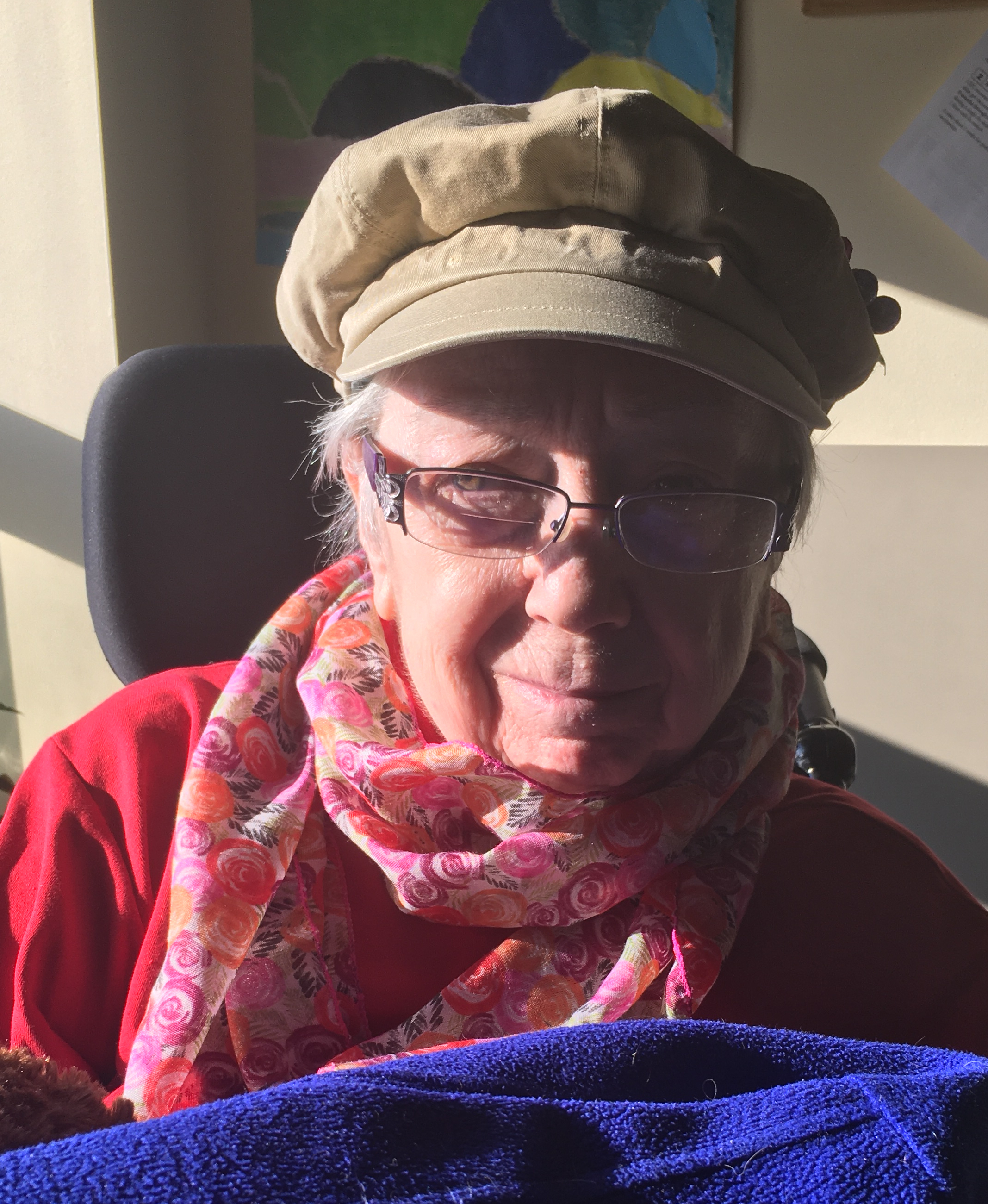
When Janis spotted me she broke into a laugh and we hugged (I’ve learned how to give a wheelchair-hug) and held hands the entire 40 minutes I was with her. Never let go of her except to change position or change hands. Aside from needing a haircut, Janis looked good. She attempted to speak a couple times but has lost most of her language, pretty inarticulate, but I would hug her and tell her I love her. Speaking into her left ear (the only one that has a smidgen of hearing still available to her.) At one point I took out my phone and played a song that Maya and I had composed. Titled: Silvery Kite, Maya composed the music on the piano, a beautiful composition, and provided the vocals. I supplied the lyrics. When I played it into Janis’s left ear she beamed and I told her it was a song that Maya and I had composed. It was for her. She chuckled and listened, I played it again. Janis and I spent most of the visit watching each other and smiling. It’s difficult to convey how pleasant this visit was, we were so caught up in the moment with each other that we went over our allotted time of 30 minutes. Nobody interrupted us.


When it was time to leave, I hugged her and told her I would be back. As I left and drove home, I felt overwhelmed but relieved that we had held out for a year and now we were back. These visits are limited (staffing is the issue) but I’m lobbying for more than one visit a month. I’ll take what I can get. As long as Covid is stable the visits may evolve back to something like normal.

And now? Well, now I wait for that next moment when we will connect again. Our moments can be seized by each of us and held hostage by way of a digital process (or the old way on film) that we know happens when we click that little button, but how does that work exactly, and does it mean anything? How is that image captured–exactly. I’m sure that a technician or scientist could elaborate the inner workings of the instrument but still, how does that happen? Shouldn’t we know this? It seems important to understand this. I wonder? Does this contain a glimpse of eternity?

What is a photograph? I mean, we know that the camera somehow captures the photo, but how exactly does that translate into a photograph? That moment in time clicked and captured digitally somehow? It’s the ‘somehow’ that I’m asking about. It’s like that reporter that wrote to Stephen Hawking asking about his ‘string theory’, “That’s wonderful Dr. Hawking, but what does it mean?” I wonder at times about such things. Is it about the energy that our nervous system can receive from this constellation of particles by our consciousness–that moment in time?

But, what does it mean, Dr. Hawking?

Janis~3/17/21

Leave a comment

Filed under Uncategorized

Leave a Reply

3 Comments

Filed under Alzheimer's, child abuse, dementia, mental health, Uncategorized

JANIS~A CORONA VISIT

A cool autumn afternoon with a shifty breeze. Janis appears in her wheelchair bundled up in her blue penguin blanket, one of those many gifts she received over the years from a wildlife organization. Today is Tuesday, September 22nd. It is a 4 pm visit. Karen, one of the activities personnel from her Unit brought her down for today’s 15 minute-Corona visit. The visits take place outside in the garden, in a large gazebo. The garden still beams with colorful flowers that blur into the changing fall foliage like an impressionist painting. This is only the second visit I’ve had with her since March 8th. These visits take place under some strictly enforced protections for the residents, staff, and the visitor. Plexiglass surrounds Janis on 3 sides and masks are required for Karen and me–the exception is Janis. (I haven’t asked, but I assume it is to protect her from us; and certain dementia patients present a unique problem for a mask.) The entire complex has not had a single case of the Covid-19 virus to date!

Janis notices me before I get to my chair (placed 6 ft. from the plexiglass) and followed my eyes all the way to my sitting. She seems more alert to me than the previous visit, and connects quickly. Again, for those who don’t know this already, she is deaf and cannot speak. Our visit requires a little skill on my part with mime. But I’m not shy, Karen is the only other person present, and I know Karen well. So I proceed with smiles and mime my happiness by patting my heart and tossing my open hand, throwing her kisses, and mouthing, “I love you. And I miss you.” Karen permits me to remove my mask briefly so that Janis can see me. A small, tentative smile from Janis is accompanied with a nodding of her head. Of course I am moved by this out of proportion to the actual behavior. A little giddy with excitement, I want to hug her and hold her hand. We have used up a few minutes already with this emotional greeting.

I use a little time conversing with Karen about Janis on the Unit, trying to keep our connection by never taking my eyes from Janis. Karen relates that staff is still impressed with how Janis’s recovery last Fall allows her to be comfortable and maintain good spirits. She says that Janis laughs frequently and responds with smiles and giving gentle pats for the care that the aides and nurses give her. She is often in light spirits. She occasionally feeds herself or attempts to with little assistance. Her appetite remains good and she is healthy. The entire time Janis gazes around at the garden; she smiles at Karen when Karen readjusts her blanket after a stiff breeze blew it off her lap. Karen also confirmed information that the administration is looking for ways to continue these visits inside as the weather shifts to winter temps.

Janis makes eye contact more frequently as the visit continues. I observe that Janis’s weight seems stable and she is far less ‘puffy’ (edema) than previous photos of her have shown, her color is good. In fact, she looks pretty good overall. I also wonder if those Zoom meetings that take place between visits (not as frequently as I would like) have something to do with this slight improvement with these limited, physical visits. The Zoom visits are not very successful in connecting with her. Janis seems to not understand this techy, virtual, substitute visitation, but it provides me with a few minutes to observe her even as a mostly one-way visit.

As our time runs out I notice my anxiety increases, however, I also note that I am less disturbed than I anticipated. And this bothers me some because I don’t want this to become the new-normal. I don’t want to accommodate to this crazy, bizarre new world for Janis and me. I want to hold her close. I want her to feel loved, to know I’m Bobby, and I’m still here with her; that she is still Bobby’s girl.

My next visit is scheduled for Tuesday, October 27th at 2 pm. A long stretch without being with her. I respect and appreciate this effort to keep her safe. And I support the restrictions this pandemic requires. However, this is becoming difficult. I find myself less patient and more concerned as time goes on. After all, time is crucial. Janis has a fatal, incurable condition. I have been with her on this Unit long enough to see how unpredictably the final day may arrive. Seemingly healthy residents one day are gone the next.

These are strange, byzantine times. Challenging in complex ways. Requiring absurd adjustments that don’t come close to normal (which is becoming an absurd descriptive term in itself). The world as we knew it seems to be standing, wobbling on its head. Like a Kafka novel on steroids.

As I’m leaving, I don’t look back. But, before I’m out of sight, Karen calls,
“Bob, she’s laughing and smiling.” For just a moment I catch myself–maybe Karen is just making sure I’m okay with this. But, I turn and wave goodbye.

“Patience is not endurance, it is loving acceptance.” ~Robert Aitken.

2 Comments

Filed under Alzheimer's, dementia, mental health, Uncategorized

entangled

Janis is still showing gains she made in palliative care last Fall. However, it appears that she has plateaued at a level where she was at a couple years ago. And, like everything about this disease, it is welcome and frustrating. Welcome because it creates hope (in spite of the realities), and a degree of gratefulness (to again, have some limited capacity to interact, communicate, to share each other during visits). Yesterday, Cathi and Sonia showed up with our cousin, Priscilla. Priscilla is now 80 years old and looks about 60-ish. (One can only hope that these genes are shared generously). Janis from her wheelchair, smiled and chuckled with recognition and excitement. She still lacks speech, other than an occasional remark which may or may not reflect context. Still, when she smiles and laughs, these are positives that indicate a quality of life.

Today was my second visit since returning from a trip with my grandson, Rob, to Virginia, to stay with Stacia and Tim for a few days. We visited D.C. and hit all the tourist sites. When we returned to Maine, Wednesday, we flew into Portland early (10:30 am). I retrieved my car from Maya’s house in Harpswell, and drove to Lewiston to visit Janis. When I arrived in her room, I stood at the foot of her bed (nap time after lunch), and when she looked up I threw my arms up and wide to display my excitement to see her. Big smiles to light up the room! We hugged and cuddled on her bed briefly while I spoke into her left ear, how much I’d missed her. Every time I pulled back to see if she had heard me, she gave a big smile and nodded. The visit went late, but as she tired I decided to leave. I told her I would be back. And, as usual, just in case she had any doubt, and to be certain that she understood, I kiss her and assure her I’ll be back. This is one of the benefits/gains that comes with her release from palliative care.

The remarkable bounce Janis got in palliative care that allowed her to recover from a hard-core decline, included, among other things, hospice care requesting that she come off all the medication, excepting two, one for pain, the other an antidepressant. Janis had been on a long-term (years) cocktail of medications, and acquired more after her placement. It was a consensus that a major, and likely, recovery from going into palliative care, was the dropping of those medications. So, I mention this that others with folks in care be aware of the side effects of long term, multiple medications and the impact that can have on patients–Janis was dying.

There are still days that are emotionally difficult, but to a lesser degree than a while ago. For four years I stubbornly avoided medication. But one day last October, I found myself incapable of denying that I was depressed. I stopped in the middle of a bout of grief one night, and took inventory of myself: my kids, and friends had expressed concern; I had lost much weight; I couldn’t sleep; no appetite, and, amid a series of poor decisions and struggling to keep bills paid (I did manage to not fall behind, but it took much longer, to double and triple my proofing before allowing myself to do each electronic payment), I recognized that I was exhausted. In all my life I have never felt such depth of dismay. Awash in guilt, regret, anger, and authentic confusion, by that I mean, almost every decision I made I had to review it a number of times before acting on my thinking (this could take a few seconds, or a day of considerable doubt). I no longer trusted myself. I tried not to display this (and this takes energy and effort!). As I ruminated almost continuously, my loss of Janis and the remainder of our time together in our retirement, I also became hypersensitive to her plight. Years. A lifetime of depression and the trauma of a childhood now lost to her, and not recoverable.

Depression. Now, I confess, I thought I knew what depression is…but, if you have not experienced it, I don’t believe it is likely that it can be truly understood how debilitating it is. My appreciation for what Janis suffered, is more heightened after this experience. I did end up on an antidepressant and within days, almost immediately felt relief. No side effects and a fresh, clear mind to get me through each day. I still have to deal with the same grief, but the experience is normalized and no longer a raging in my brain to fight for the focus to get things done.

When I visit Janis now, I am able to be 100% available to her in every way, for the entire time. And I can now focus on Entangled, which has been held hostage for nearly five years.

1 Comment

Filed under Alzheimer's, child abuse, dementia, mental health, Uncategorized, Writing

Update on Entangled

I recently completed the first draft of Entangled. I posted it on Facebook. Maine Novels by Robert Chapman. I will add some notes to the website robertwchapman.com and return to start a first round of editing and proofing. I hope to hire a professional for these two tasks as well as doing my own work on it, but truth be told, it is not recommended that a writer proof their own work. (Can’t always see your own errors or other transgressions.) Entangled is something like a memoir, but not formatted or organized as a traditional script. I like to think that it is my testimonial to the girl I fell in love with in high school and the woman I love today. Janis resides in a Unit for people who suffer dementia. However, we continue our love and our relationship today…together/apart. This book is an attempt to share our love, marriage and the unique inclusion of what Janis brought to our lives. Janis had multiple diagnoses that were the result of childhood abuse. Our love, our marriage, our lives, were caught up in the web of that early trauma. This is about my love for her and her courage and struggle with a childhood lost.

My next step is to continue to proof the text while looking to publish. This next step also involves sending the draft for our children to review before I publish. I also have someone to do the Forward to the book. A retired LCSW with experience in private practice with trauma, and in child welfare work as well. Very important credentials for this book. Then, I also want some input into design of the interior text and the cover. I am doubtful that publishers will allow me that kind of involvement. Traditional publishing companies usually want that kind of contractual control for purposes of marketing. If they do not allow me to have some creative input then I will go back to self-publishing. (Marketing is not my priority, I don’t need the income. Besides…what am I gonna do with a million dollars? Wait…

2 Comments

Filed under Alzheimer's, child abuse, dementia, mental health, Uncategorized, Writing

The Perfect (Brain) Storm (part one)

There are two bodies of work that I want to present at the beginning of this post, and if I can figure out how, I will attach a couple of links for those interested in looking into this a little more.

The first is a huge body of research by Vincent Felitti, MD, with the Kaiser Permanente Medical Care Program in San Diego:  Turning Gold into Lead, The Relationship of Adverse Childhood Experiences to Adult Health (ACE Study). I met Dr. Felitti at a training workshop several years ago. Later, following the publication of my book, A Certain Fall*, he invited us both to a workshop in Bangor, Maine. I introduced him to Janis. We spoke for a few minutes about her history and the ACE Study.

The second is a recent book by Robert M. Sopolsky,  professor of biology and neurology at Stanford University.  BEHAVE, The Biology of Humans at Our Best and Worst. A book that covers, as the title states, biology, the nervous system and the impact of child abuse on the brain and physical health of humans. This book, though a little challenging (kinda technical and immensely detailed in places) is a humbling and sobering look at what happens to the brain and bodies of children suffering abuse. And coupled with Dr. Felitti’s work, and my own thirty plus years in child welfare, jolted me, when I understood what I had intuited all these years with Janis: she suffered The Perfect (Brain) Storm.

As I continue to work on Entangled, I sometimes get lost in the 50+ years of our lives together. Adding to that, the theme of the book is not just a biographical text, but a text that describes how Janis fought back against the darkness, the fog of depression that covered all  her days, the courage, the determination it took to get through her daily life. And in the end to leave her home, her two cats, her trips to the sea collecting sea glass, her family, and enter a locked unit to wait…

So why write about this? Really. It’s depressing. Why? Because Janis wanted to help others. She held a deep compassion and empathy for victims (including all wildlife and domestic animals. I’m still wading through all the mailings, magazines, and materials she subscribed to. Anyone need a free wildlife calendar? Or maybe some cute kitten stickers, address labels? Wrong address a problem?) She and I hoped that by sharing about her life it may help, even just a little, to build an awareness of the significance of early childhood abuse and the disastrous effect it has on our society. I’m convinced that if we can find a way to end or at least diminish the prevalence of child abuse in our culture, hell, all cultures world wide, it will make life a little sweeter for all our children, but as Felitti and Sopolsky attest, it may solve most of society’s problems: physical and mental health, addictions, violence, etc.

These posts will promote both of the above texts and point out some of the findings they have generated. It is an education worth pursuing.

Okay. Now how do I link you to some data sites?  Hmmm. If all else fails, check my Facebook page for a link to any sites that carries information on the ACE Study.

* A Certain Fall, published in 2005 is now out of print, I will be revising and updating this book for a new edition. There may be some old, early editions available as used books via Amazon.

http://www.robertwchapman.com / FB: Maine Novels by Robert Chapman


Leave a comment

Filed under Alzheimer's, child abuse, Writing

“UNTITLED”

do you remember

our first kiss?

me walking you home

holding hands beneath shy stars?

do you remember this?


do you remember

our small farm in winter

blanketed in deep snow?

in spring? in summer?

peepers in the pond

crickets in the fields?


do you remember

bright autumns

carousel of colors

burning leaves

laughter of our children?

do you remember this?


do you remember

our first kiss?

the touch of my hand?

the color of my eyes?

do you remember this?


strolling  an ocean beach

seeking peace and treasures

gifts from the sea?

do you remember me?


~9/3/2016


Leave a comment

Filed under Alzheimer's